

Summary
Every leader lives with the same gap - you can't sit in every meeting, read every message, or watch every commit, and the things you can't see are often the things that bite you. Observer Agents close that gap. They're autonomous AI experts that continuously watch the qualitative fabric of your business, investigate on their own when something looks off, and only come to you when there's genuinely something worth your attention. It's a new kind of visibility for leaders - and a different kind of accountability partner entirely.

Table of contents
You Lead. They Watch. Introducing Observer Agents
TL;DR
Every leader since the dawn of management has lived with the same quiet frustration - as you scale, you lose visibility. You just can't see everything that's happening inside your business, and the things you can't see are often the things that bite you.
To help, we've focused more on dashboards and the numbers that drive them. KPIs have helped, even if they come with their own well-documented blind spots, and hiring a great leadership team helps more. But the biggest limiting factor is that no leader has the time to check every calendar, watch every commit, follow every customer conversation, or see every ticket, and keep their "finger on the pulse" of the whole business. Having that kind of visibility would be incredible for running a high-performing business, but it's simply been bigger than any human could absorb beyond the earliest startup phase.
Until now: introducing Observer Agents.
Observer Agents see everything
Observer Agents are autonomous AI experts that run continuously in the background of WorkSights AI. They watch the full qualitative fabric of your business: every meeting on every calendar, every file being edited, every commit message, every CRM update, every task update, every ticket being opened or closed. Not content scraped from people's screens - just the metadata of the work itself, continuously, across every tool you've connected to WorkSights AI.
This is a genuinely new capability. For most of the history of management, the qualitative signal of a business - the texture of how people were actually working - was only visible to the small group of people who happened to be in the room. Once a company got too big to fit in the same Uber, that visibility was effectively lost. Observer Agents recover it, and then some.
They understand what they're seeing
Seeing isn't enough on its own. A camera sees everything and understands nothing, which is why the older generation of "employee monitoring" software ended up so useless, and so creepy.
Observer Agents are different. Each one is built around a specific area of expertise - sales performance, engineering productivity, team health, and more on the way - with the context it needs to interpret what it's looking at. They know the shape of a high-functioning revenue team versus a pipeline that's quietly cooling. They know what engineering momentum looks like when it's real and when it's theatrical. And they can tell the difference between a team that's coordinating and one that's drifting apart. And because WorkSights AI knows the role of each user, each Observer stays focused on the right people for the right jobs when it's running its analysis.
Think of them less as automated reports, and more like having a team of senior advisors - the kind of experienced operators you'd normally pay a fortune for - quietly reading the texture of your business, hour by hour, and making sense of what it means, for a few dollars a day.
When something looks off, they dig deeper on their own
This is where Observer Agents separate themselves from every reporting or alerting tool that's come before.
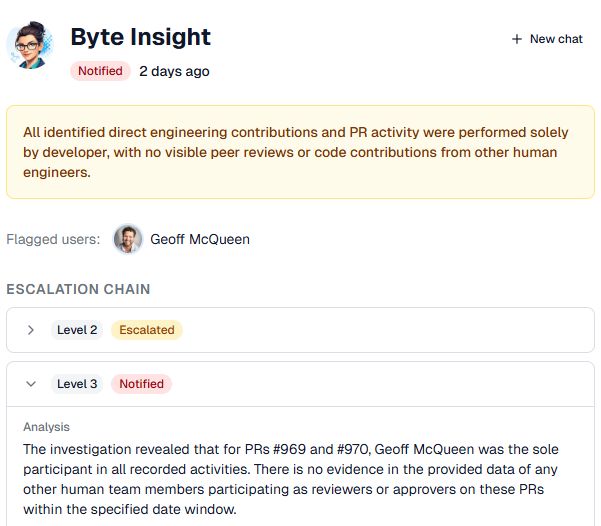
When an Observer spots something that looks interesting - a concerning email or meeting, a pattern that doesn't match a healthy team, a signal that doesn't quite add up - it doesn't just mindlessly flag it. It takes its initial read of what might be going on, writes itself a sharper follow-up question, and runs again with a deeper analysis and more AI “thinking” budget. If that pass surfaces something worth pursuing further, the Observer goes deeper still, using the output of its last investigation as the starting point for the next. It iterates until it's either convinced there's something genuinely worth your attention, or satisfied that the signal it was chasing turned out to be nothing. And it only sends you a message if it thinks there’s something worth your time to know.
This self-directed, compounding investigation is what makes Observers feel different than anything that has come before. It's the difference between a dumb alert ("this number changed, please look at it") and a senior advisor who's thought about the thing for an hour, chased down a few possible explanations, and can tell you with confidence what they believe is going on and why.
Which means they only interrupt you when it matters
The biggest risk with any continuous intelligence system is that it becomes another firehose of notifications you learn to ignore. Every leader has a graveyard of dashboards and alert channels that started out useful and quietly drifted into background noise.
Observers are designed to avoid that fate. Because they investigate before they escalate, the only time you hear from one is when its own analysis has convinced it there's something real - and when it does reach out, it arrives with the full reasoning chain attached, so you're never handed a conclusion without the thinking behind it. When there's nothing worth raising, the Observer stays silent and files what it saw away as memory for future context and conversation.
An example from our own deployment makes the point. In its first week running against the Ascendius team's data, our engineering Observer surfaced findings that flagged that our own founder was working long days and moving fast on their own. That's a legitimate risk in most businesses, and while at this stage of our startup journey it is a feature, not a bug, the fact the Observer worked this out on its own was truly incredible.
Observers surface what the data says, not what the leader - or the founder - would prefer it to say.
Observers, not agents
The AI industry is currently in love with "agents" that take action on your behalf: booking meetings, sending emails, opening tickets, shuffling records between systems. That's interesting work, and there's clearly a place for it, but it's not the work WorkSights AI is designed to do.
Observer Agents are deliberately different. They don't do the work; they watch the work being done, across your people and your tools, and help you see it more clearly. Their job is to illuminate, not automate. You lead. They watch. That's the whole product in four words.
The bottleneck in most businesses isn't the execution of decisions - it's the visibility needed to make good ones, with confidence, in the first place. A leader’s business and their team members are too important to accept “trial and error” as the best you can expect.
Three Personas Today, More To Come
Observer Agents are designed as a family, and WorkSights AI ships at launch with three of them. Each is tuned to a different layer of the business:
- Rev watches the revenue and sales-facing activity in your stack - customer meeting cadence, CRM hygiene, whether sales-facing effort is actually going where a high-performing revenue team should be spending its time. The goal is catching early signals of pipeline risk or engagement decline before they show up in “the number”.
- Byte thinks like a senior engineering advisor. It reads across GitHub, Jira, Notion, Basecamp, Monday, and the rest, looking at who's shipping, who's blocked, where effort is landing, and whether the rhythm of the team points to momentum or drag.
- Vibes focuses on the cultural and collaborative layer of performance - how people are working together, whether collaboration is deepening or fragmenting, and whether team presence and engagement look like a business that's firing or one that's quietly coasting.
These three are a starting point, not the final roster. The architecture is designed to make spinning up new Observers straightforward for any functional layer of a business - finance, operations, customer success, people ops, anything you can define a pattern of excellence for. Expect the library to grow, and expect the ability to configure your own.
A different kind of accountability partner
The honest way to describe Observers is that they're tough. They don't miss things, and they aren't particularly worried about whose toes they might step on, including the people who built them, as our own Byte finding made plain.
A reader on LinkedIn framed it well after we introduced the concept last week: “most of the systems around us are built to confirm what we already believe”. An Observer with no ego, no politics, and no stake in the outcome - one that just tells you what's true - is a different kind of accountability partner altogether.
That's the trade Observers are offering. They won't flatter you, and they won't soften an uncomfortable finding to make it land more easily. They'll tell you what the activity across your business actually shows, with the reasoning attached, and then it's on you to decide what to do about it.
For leaders who actually want to run high-performing businesses, that's the right trade.
Get started
Observer Agents are live now for WorkSights AI beta users. Rev, Byte, and Vibes are active by default, with configurable cadences and editable prompts so you can tune them to your business, your strategy, and the specific shape of what you consider high performance. Every observation connects directly into WorkSights Chat, so when something gets flagged, you can go deeper in conversation before anyone else on your team gets involved.
If you're ready to find out what's actually happening across your business - including the parts that haven't made it into a dashboard yet - get started here.